



Intraday Market Thoughts Archives
Displaying results for week of Aug 11, 2013Ashraf on CNBC about USD, CHF, Fed & BoE
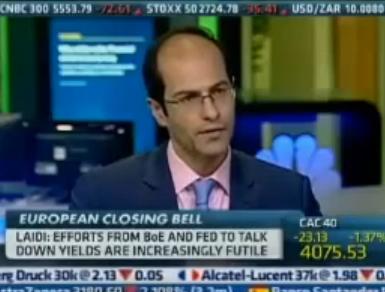
Ashraf discusses the latest conflicting US data signals, central banks' eroding powers in containing yields and views on GBP, CHF & EUR. Interview link
Dollar Dumped, Gold Breaks Out
A wave of economic data initially boosted the dollar but pain the bond and stock markets led to a complete turnaround in volatile trading. The Swiss franc was the best performer while the US dollar lagged. After all the excitement, markets will have a chance to digest the moves in Asia because there is no economic data on the calendar.
Thursday's trading was enough to leave the most level-headed analyst a bit confused. A number of cross-currents hit the market:
- US CPI numbers were close to expected but hit the Fed's target of 2.0%
- Initial jobless claims fell to the lowest since 2007
- Several US manufacturing numbers were worse than expected
- Executives at Wal-Mart and Cisco warned about the economy
- Chinese Treasury holdings fell $20B in May
Those headlines have differing meanings for different markets and for the Fed. The stock market focused on the negativity from corporates and dropped to a one-month low. The employment, CPI numbers and Chinese flow data spooked the bond market, pushing yields to 2-year highs, breaking 2.75% resistance in 10-year yields.
The FX market was caught in the middle. Risk-off trading and tapering boosted the dollar initially but EUR/USD couldn't fall below 1.3200 and cable remained relentlessly bid. Eventually, declines in stocks weighed on USD/JPY and boosted demand for gold.
As USD/JPY fell to the lows of the day and gold broke key resistance at $1350, a wave of dollar selling hit. Even the commodity currencies made big gains against the dollar and a short-squeeze was likely part of the story.
We will watch how this develops but the breakouts in stocks, bonds and gold can't be ignored and point to interesting days ahead.
Disinflation, Disinterest and Disappointment in Global Growth
Simmering inflation fears and a surprising warning about the global economy grabbed the spotlight Wednesday. The pound and kiwi were the best performers on the day while the Swiss franc lagged. Aussie inflation expectations highlight a middling calendar and Thursday is the Assumption Day holiday in large parts of Europe so it will be especially quiet.
The market is increasingly focusing on inflation numbers, especially with US CPI coming on Thursday. The Fed's Bullard warned that the officials could lose credibility if they can't bring inflation up to 2%. On the other hand, he said stimulus risks long-term inflation.
The disinflation side gained some leverage on Wednesday with the year-over-year producer price index at 2.1% compared to 2.4% expected. The dollar easer lower on the numbers, a sign that traders are starting to pay attention.
The bigger news might have been from computer networking equipment maker Cisco after the stock market close. The company has access to leading edge data on global corporate investment spending and CEO John Chambers was sour on the global economy cutting 5% of his workforce. He said the recovery continuing slowly but it was more inconsistent than expected.
On the day, trading was sluggish. Cable sprung to life on the strong claimant count numbers but US trading was slow. AUD/USD raised some eyebrows partway through the session as it quickly climbed to 30 pips to 0.9160 but the move stalled and it slipped back to 0.9125.
Looking ahead, a series of low-tier indicators are on the Asia-Pacific calendar but nothing likely to move markets. One to watch comes at 0100 GMT with August Australian consumer inflation expectations. A quick fall from the 2.6% July reading might put another rate cut on the table.
| Act | Exp | Prev | GMT |
|---|---|---|---|
| Consumer Inflation Expectation (AUG) | |||
| 2.6% | Aug 15 1:00 | ||
| PPI (JUL) (m/m) | |||
| 0.0% | 0.3% | 0.8% | Aug 14 12:30 |
| PPI ex Food & Energy (JUL) (m/m) | |||
| 0.1% | 0.2% | 0.2% | Aug 14 12:30 |
| PPI (JUL) (y/y) | |||
| 2.1% | 2.4% | 2.5% | Aug 14 12:30 |
| PPI ex Food & Energy (JUL) (y/y) | |||
| 1.2% | 1.4% | 1.7% | Aug 14 12:30 |
GBP Focus on 2-Year Spreads
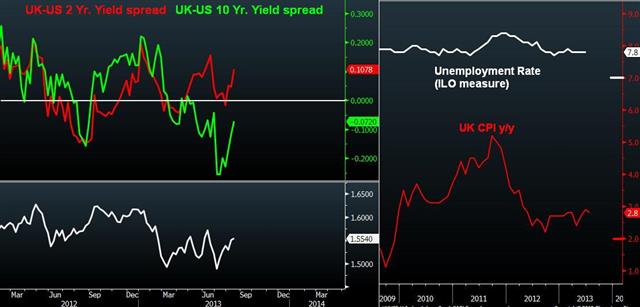
UK 2-year yields further surpass their US counterparts into positive territory while 10-year gilt yields are not far from doing the same. The sharper move in the UK-US 2 year spread to 0.11% is a manifestation of the 3 exceptions given by BoE governor Carney regarding his forward guidance on keeping rates low for about 3 years. Full chart & analysis
Dollar Sails on Retail Details
The US dollar was the top performer for the second consecutive day while the yen was the laggard. The Asia-Pacific session features Australian wage costs. Today's premium trades weighed the fundamental and technical strengths and weaknesses regarding EURUSD, with 2 trades on the pair as well as daily and weekly charts Both of the longs in EURGBP were filled and in progress. All trades and rationales are in the latest Premium Insights.
Never underestimate the spending power of the US consumer. Overall sales were fractionally below expectations but upward revisions and solid results excluding volatile items gave the dollar a boost. Coming into US trading, USD/JPY was already much higher as the market digested chatter about Japanese corporate tax cuts.
After the retail sales numbers, US dollar strength extended and spread. Bonds were a large factor as 10-year yields jumped 10 basis points to 2.72%. That's perilously close to the cycle high of 2.75%. If that level breaks, it could underpin a larger dollar rally.
Trading action was particularly concentrated in EUR/GBP on Tuesday as a wave of stops below 0.8580 sparked a near-instantaneous drop to 0.8535. The carnage spilled over to EUR/USD, eventually leading to a half-cent decline.
The taper debate continued with Lockhart mostly stressing that the Fed is data-dependent. One interesting comment was that only 'very weak employment' would prevent a wind-down of the program. He also referred to risks of disinflation. Together the comments stress that the market may be misinterpreting the Fed`s internal debate on the taper.
In the hours ahead the market will continue to focus on the stock markets in Japan and China but economic data will also be in the spot light. Up first, at 2245 GMT, New Zealand releases Q2 retail sales data. Expectations are for a whopping 1.5% quarter-over-quarter rise, highlighting the spending power of New Zealanders due to house price rises.
Later, at 0130 GMT, Australia releases the Q2 wage cost index. A 3.0% rise is expected but a higher number could further dim future AUD rate cut hopes.
| Act | Exp | Prev | GMT |
|---|---|---|---|
| Core Retail Sales (m/m) | |||
| 0.5% | 0.4% | 0.1% | Aug 13 12:30 |
| Retail Sales (m/m) | |||
| 0.2% | 0.3% | 0.6% | Aug 13 12:30 |
| Retail Sales ex Autos (Q2) (q/q) | |||
| 0.6% | Aug 13 22:45 | ||
| Wage Price Index (Q2) (q/q) | |||
| 0.8% | 0.7% | Aug 14 1:30 | |
| Wage Price Index (Q2) (y/y) | |||
| 3.0% | 3.2% | Aug 14 1:30 | |
Dollar Climbs, Retail Sales the Next Hurdle
A small relief rally boosted the dollar after relentless losses last week. Gold was also strong, climbing toward the July high while the Aussie lagged. The June BOJ minutes and Japanese machine orders are on the calendar in Asia.
A Fed study offered another hint that tapering is coming soon. A study from economists at the NY and SF Fed indicated the vast majority of stimulus since QE has been due to forward guidance rather than asset buying. If the FOMC believes the study it would give them another reason to taper in September as they look to mitigate financial risks.
The dollar could also benefit from better budget numbers in the US. The July deficit was $97.6 billion, which was slightly higher than estimates but the year-to-date deficit is at $607 billion compared to $974B at this time last year. The improving budget could ease rhetoric in Congress and help forge a budget deal – something that could pave the way for a strong year of US growth in 2014.
USD/JPY climbed above 97.00 early in Asia-Pacific trading after failed attempts at that level on Friday and Monday. Overall, market moves were limited to 50 pips on the day. The Australian dollar slipped back to 0.9140 despite chatter about Chinese stimulus. At this time of year, flows rather than fundamentals can take the drivers' seat.
The big mover to start the week was gold as it continued a week-long climb from $1272 to as high as $1343. The rally now closes in on the July high near $1350. That will be a key pivot in the days ahead.
The next times on the calendar are from Japan with the June machine orders report at 2350 GMT. Expectations are low with the consensus calling for a 7.0% m/m decline. Markets may be extra-sensitive to the data after yesterday's disappointing GDP numbers. At the same time, the BOJ releases the minutes of the June 10-11 meeting.
| Act | Exp | Prev | GMT |
|---|---|---|---|
| Retail Sales (JUL) (m/m) | |||
| 0.3% | 0.4% | Aug 13 12:30 | |
| Retail Sales (ex. Autos) (JUL) (m/m) | |||
| 0.4% | 0.0% | Aug 13 12:30 | |
| GDP Annualized (Q2) | |||
| 2.6% | 3.6% | 3.8% | Aug 11 23:50 |
| GDP (Q2) (q/q) | |||
| 0.6% | 0.9% | 1.0% | Aug 11 23:50 |
| GDP Deflator (Q2) (y/y) | |||
| -0.3% | -1.1% | Aug 11 23:50 | |
USDJPY's 87% August Record
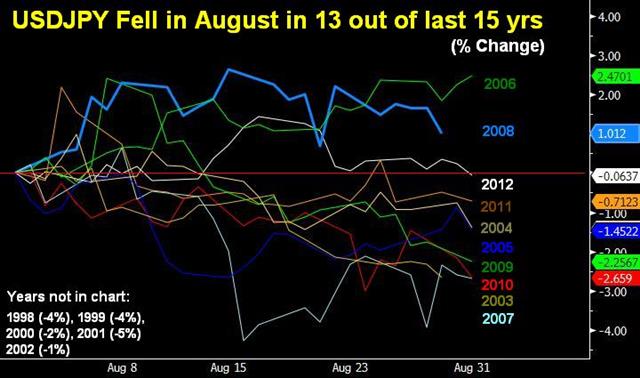
August is the month when USDJPY fell in 13 of the last 15 years (87%), with 2006 and 2008 being the only exceptions since 1998. Repatriation of August coupon payments from US treasury bonds by Japanese investors has long been attributed to the yen's summer gains. So what happens now and beyond? Full charts & analysis
Onto Japan GDP, EURUSD Hit Net Longs
USD/JPY is slightly higher to begin the week but upcoming Japanese Q2 GDP numbers could quickly change the picture. The Australian dollar was the best performer last week while the US dollar lagged. The latest CFTC data shows speculators betting on the euro for the first time since May.
The moves in early week trading are modest but the Australian dollar is a quarter-cent lower after a sizeable rally last week. The WSJ and others wrote about China on the weekend and the consensus is turning more optimistic, especially after Friday's rise in industrial production (+9.7% vs +9.0% exp).
The Canadian dollar was particularly noteworthy on Friday with a loss of 39K jobs compared to a gain of 10K expected. USD/CAD rose a half-cent on the headlines then quickly turned around and finished at the lows of the day. A quiet summer market or corporate flows could explain the turnaround but strong demand for Canadian dollars could also be the culprit – something that would point to a larger USD/CAD decline.
The SNB was in the headlines on the weekend, warning that banks are underestimating the real estate risks of rate hikes. The comment could be an early step aimed at preparing the financial sector for the end of the EUR/CHF floor.
A big test for Abenomics, at least from the general public's perspective, comes at 2350 GMT when Japan releases Q2 GDP. Annualized GDP is expected at a rousing 3.6% pace, or 0.9% q/q. One focus will be nominal GDP (exp +1.0% q/q) because curbing deflation is a key government goal.
Commitments of Traders
Speculative net futures trader positions as of the close on Tuesday. Net short denoted by - long by +.EUR +6K vs -8K prior JPY -80K vs -82K prior GBP -46K vs -49K prior AUD -77K vs -73K prior CAD -10K vs -11K prior NZD -1K vs -1K prior CHF -0.3K vs -1K prior US Dollar Index longs at 25K vs 25K prior
A shift toward neutral from the ECB has cleared out bets against the euro while GBP shorts remain aggressive, leaving a larger risk of a squeeze. The greatest risk of a stop-driven rally is in AUD, where the short position is at a cycle high.
| Act | Exp | Prev | GMT |
|---|---|---|---|
| GDP Annualized (Q2) | |||
| 3.6% | 4.1% | Aug 11 23:50 | |
| GDP (Q2) (q/q) | |||
| 0.9% | 1.0% | Aug 11 23:50 | |
| GDP Deflator (Q2) (y/y) | |||
| -1.1% | Aug 11 23:50 | ||
| Industrial Production (JUN) (m/m) | |||
| -3.1% | 1.9% | Aug 12 4:30 | |
| Industrial Production (JUN) (y/y) | |||
| -1.1% | Aug 12 4:30 | ||