


Intraday Market Thoughts Archives
Displaying results for week of Oct 13, 2013Picking Sterling's July Bottom
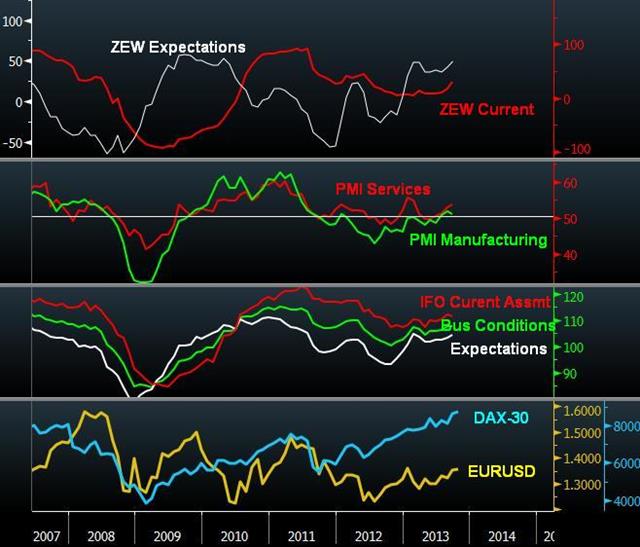
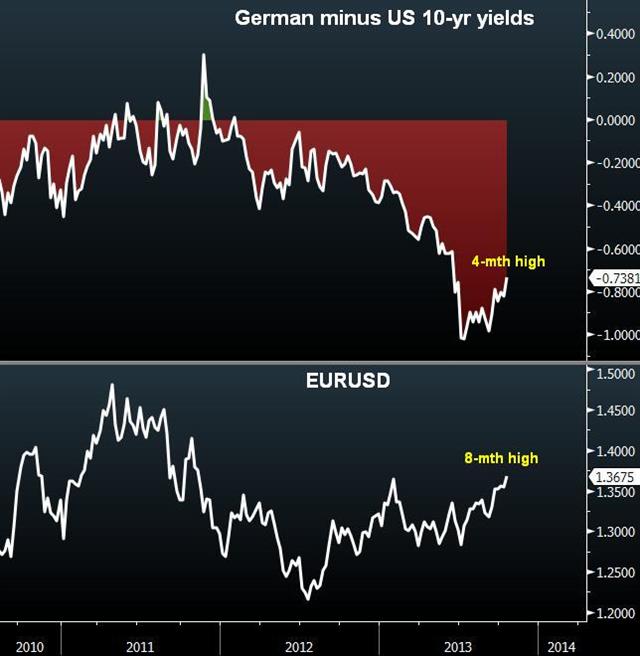
Both EURUSD and GBPUSD rallied markedly from their July low, gaining 7.5% and 9.5% respectively. Considering the 2013 high for GBPUSD stands at 1.6381, compared to 1.3711 for EURUSD, there appears greater upside potential for sterling from current levels. Friday's IFO release from Germany is expected to replicate the positivity seen in this week's release of the ZEW. The clearer danger to EURUSD emerges from none other than the next ECB press conference, which is in 3 weeks' time. Until then, expect ECB officials to shed light on the Eurozone's extremely low inflation rate and reiterate their stance on forward guidance for low rates. But the road past 1.37 faces fewer challenges than 8 months ago. Our Premium subscribers will note that the last SHORT trade in GBPUSD was on May 29 and every trade thereafter was a LONG. Over 60% of the trades hit all targets, while the rest were either stopped out or unfilled. The use of multi-time frame momentum analysis enables the differentiation between corrective and impulsive moves, as well as the pinpointing of new trends.
Why The Pound Can Confound
Trading in the first half of the year was based on an improving US economy and Fed taper. That hasn't happened and US dollar lagged Thursday while cable led the way. We look at the underlying reasons for cable strength and preview the China Q3 GDP release up later.
Many of the themes of the early part of the year reversed and converged Thursday. Earlier, Ashraf wrote about the change in fortunes in the euro. The US recovery was the main theme in Q1 and a potential double dip in the UK was another one.
The consensus forecast for US growth this year is a measly 1.6%, that's about half of what many economists (and the Fed) were looking for at the start of the year. That could be revised even lower on the shutdown.
The consensus on UK growth is now 1.3%, a shade below to US growth. Through the first few months of the year there was plenty of talk about negative growth in the UK this year.
In politics, Cameron has been harsh and divisive but he's also been clear and decisive. US Congress has failed on virtually every level.
So it's no wonder cable has ripped higher over the last month and climbed another 200 pips on Thursday to 1.6160. The Fed continues to print and a taper in December or even January is now questionable. Meanwhile, if we see another dip in UK unemployment the BOE may consider abandoning its forward guidance or adjusting it.
The big anti-dollar trade on Thursday came as the market priced in no taper. Earlier in the month, traders were hesitant to bet against the dollar because the chance of disaster from Congress. The market will likely head into next week with a more balanced view and a focus on economic data.
As the week winds down, the top release is Chinese Q3 GDP at 0200 GMT. The consensus is for 7.8% y/y growth. At the same time, industrial production is expected up 10.2% y/y and retail sales up 13.5% y/y. The high-flying Australian dollar may be vulnerable to a snapback on any signs of disappointment.
| Act | Exp | Prev | GMT |
|---|---|---|---|
| Unemployment Rate (SEP) | |||
| 7.3% | 7.3% | Oct 18 | |
| Retail Sales (SEP) (m/m) | |||
| 0.6% | 0.4% | -0.8% | Oct 17 8:30 |
| Retail Sales ex-Fuel (SEP) (m/m) | |||
| 0.7% | 0.3% | -0.8% | Oct 17 8:30 |
| Retail Sales (SEP) (y/y) | |||
| 2.2% | 2.1% | 2.1% | Oct 17 8:30 |
| Retail Sales ex-Fuel (SEP) (y/y) | |||
| 2.8% | 2.1% | 2.3% | Oct 17 8:30 |
Euro’s Ascent: Between Now & Then
We've already compared the TECHNICAL dynamics in the euro's flows between this month and February for our Premium subscribers in past editions. Now we compare today's fundamental dynamics with those of early February (when the EUR peaked at 1.3711 before losing 7% in the ensuing 2 months) 3 Differences between February 2013 and now. Full charts & analysis
After Congress Seals Deal, What’s Next?
Congress is expected to vote on a deal to end the fiscal impasse late on Wednesday. Risk assets cheered the news all day with NZD leading and JPY slumping. The vote is expected to be straightforward but the market won't take anything from Washington for granted.
The three-week shutdown and debt ceiling ordeal is nearly over with almost nothing to show from it. There were no substantive changes to Obamacare and the can was kicked on funding the government until January 15. The new debt ceiling will hit Feb 7 but accounting measures can still be used to extend it.
The lone victory for Republicans is a pledge to negotiate for a budget agreement by mid-December but progress there is hardly written in stone.
With the crisis finally averted the market will look for a new theme. In the immediate term, corporate earnings are in focus. So far numbers have been mixed but the latest from IBM was disappointing and shares are trading at a two-year low.
The next focus will be the health of the US economy. It's rumored that non-farm payrolls will take 2-3 days to release but there has been no confirmation. Other key data points include retail sales and CPI. In order to get a full assessment of the impact of the shutdown we will have to wait until at least mid-November.
The outlook for the US economy is cloudy and despite the challenges in interpreting data, expect the market to be hyper-focused on the numbers.
The calendar for Asia-Pacific trading is light but the Senate will vote on the deal around 2200 GMT and the House a few hours later.
Senate Deal On, Taper Cearly Off
The US debt can is kicked at ever shorter distances as markets cling to hopes that US Senate leaders has reached a deal to re-open the government until January 15 and raise the debt ceiling until February 7th with a $986 bn funding. While a Senate deal is on, Fed tapering of asset purchases shall remain clearly off well into year-end. Full Analysis
Fitch Threatens US Downgrade, House to Vote
House Republicans threw a wrench into negotiations on Tuesday. The yen was the top performer on the day as risk aversion rose. Fitch put the US rating on a negative watch for a downgrade with the debt ceiling days away.
House Republicans will advance their own bill to end the fiscal impasse late on Tuesday. It would reopen the government until Dec 15. It's unclear how much opposition it will face from the left and extreme right in the House and the upcoming vote is expected to be close. If it passes, it's highly unlikely to get by the Senate.
Markets scoffed at the surprise move from the House, sending the S&P 500 down 0.7% and USD/JPY down about 40 pips. Gold was a main beneficiary, climbing to $1285 from $1255.
Despite the surprise, the broad strokes of the House plan are similar the Senate negotiations. Critically, repealing the medical device tax is no longer on the table and that represents some progress.
The bigger surprise came after US stocks closed. Fitch placed the US on ratings watch for a downgrade sometime before the end of the first quarter. They warned about weakening political resolve and international standing as key risks.
The headlines sent USD/JPY quickly below 98.00 before the pair rebounded to 98.20. Economic news also continues to reflect badly on the US as the Empire Fed fell to the lowest since May.
Outside of the constant headline watching from Washington, one of the big stories was the breakout of the Australian dollar. AUD/USD is at a 3.5 month high and EUR/AUD fell below its recent lows. Technically, the charts are interesting and fundamentally the RBA minutes didn't have any hints about rate cuts.
New Zealand CPI at 2145 GMT is the top item on the calendar. A rise of more than 0.9% q/q expected would further bring forward the possibility of rate hikes and give the kiwi fresh life. Otherwise, all eyes will be on the House vote.
| Act | Exp | Prev | GMT |
|---|---|---|---|
| Consumer Price Index (Q3) (q/q) | |||
| 0.9% | 0.9% | 0.2% | Oct 15 21:45 |
| Consumer Price Index (Q3) (y/y) | |||
| 1.4% | 1.3% | 0.7% | Oct 15 21:45 |
The De-Americanized World
Congress continues to stumble toward a solution to the dual self-inflicted wounds of a government shutdown and debt ceiling. The latest deal will extend the debt ceiling until mid February but the long term consequences of the squabbling are becoming more clear.
The latest headlines from Congress suggest a debt ceiling extension until February 15 in exchange for rules that would eliminate accounting measures to extend future debt ceilings. In essence, it would make debt limits strict.
The other part of the deal would reopen the government until mid-January in exchange for comprehensive deficit negotiations.
The sum achievement of holding the government hostage for three weeks is almost nothing and the saga could repeat itself in months. A Chinese commentary in the official press may have penned a phrase that will reverberate for years with the call for a 'De-Americanized world'. In the heat of the crisis moment, the debt ceiling feels bigger than it really is but the drawn out saga has attracted the world's attention and, almost universally, the world's disdain.
In order for the United States to lead and set the agenda for the global economy it needs leadership worth following. Few would argue that Congress is a beacon worthy of America's military and economic might.
What's next is a slow erosion of US influence. In the 1990's America was able to forge the Washington consensus -- an economic leadership that blasted down the doors of closed markets and led to waves of privatization, for better or worse. That kind of clout is gone and what's left is eroding daily.
We warn against overreacting in the short-term but it's hard to imagine the US dollar will still be the sole reserve currency in 30-50 years.
Coming up later is the minutes of the latest RBA meeting. The 0030 GMT release could help shed some light on Steven's thinking but with the RBA sidelined, market reaction may be tame.
Euro’s German Rally
As the US debt ceiling deadline approaches and the US govt remains partially shut for the third straight week, figures from Germany remain robust. The Bundesbank said last month Germany's economy had an “extraordinarily good” consumer climate, supported by the lowest unemployment rate in over 20 years. Full charts & analysis