



Intraday Market Thoughts Archives
Displaying results for week of Apr 14, 2013GBP Fears GDP After Downgrade
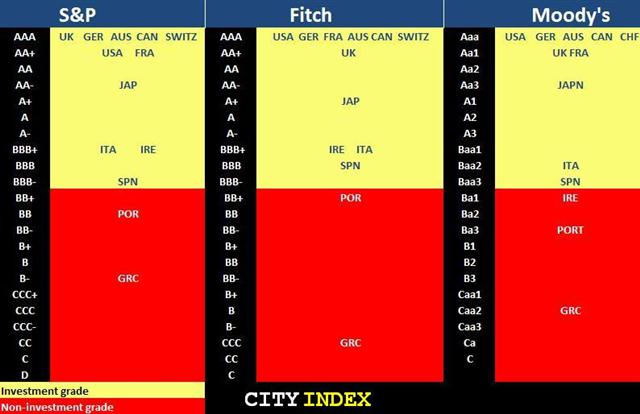
Four weeks after the UK announced its budget for 2013-14, Fitch removes the UK credit rating from its AAA perch, downgrading it to AA+ and issuing a stable outlook. As rating downgrades become the norm, markets are placing more weight on the accompanying outlook to glean an idea on the likelihood of further action. Standard & Poor's is the only major credit agency with AAA rating on the the UK, while Fitch is the only agency with a AAA rating on France. For all major credit ratings by all 3 credit agencies, view here
Fitch Downgrades UK, New Insights Added
Fitch downgrades the UK rating to AA+ from AAA, while leaving the credit outlook stable. S&P is now the only credit agency to remain with AAA rating for the UK. Sterling fell across the board, settling around $1.5230s, while attempting to hold above 151 yen ahead of the conclusion of the G20 meeting this weekend. Euro quickly pared gains trigered by Weidmann's clarification that a rate cut would only be considered by deteriorating data. We added new trades in GBPJPY, EURUSD, USDJPY, gold and silver as well as a monthly Gold/Silver ratio with multi-speed momentum. All trades and charts in the latest Premium Insights.
Philly Fed Misses, BOE’s Weale Dovish
Risk trades slipped on a disappointing Philly but overall moves were choppy. The pound was the top performer while NZD lagged. The Asia-Pacific calendar is light. Premium trades existing in EURUSD, USDJPY, GBPUSD, EURJPY, USDCAD and gold. The remaining silver short hit all targets and so did 1 Gold short, keeping 2 in progress and 3 unfilled. Full access can be seen in the latest Premium Insights.
Yesterday's Beige Book affirmed that the Fed remains upbeat about the recovery but today's economic data raised another set of questions. The Philly Fed was at 1.3 compared to 3.0 expected, which alone isn't bad but the key sub-indexes on employment and new orders slumped. Leading indicators also slipped 0.1% compared to a 0.1% rise expected.
Earlier data on initial jobless claims at 352K were essentially in line with the consensus.
Following the Philly Fed, risk trades slumped and USD/JPY fell to 97.92. Yen crosses also hit the lows of the day at that time. Afterwards stocks continued to deteriorate but FX rebounded and spent the remainder of the day moving sideways.
In the UK, an interesting development was a comment from the BOE's Weale that he might support futher easing. He conceded that growth may have contracted in Q1 and said lower inflation improves the case for more stimulus. The most-recent MPC minutes showed a 6-3 vote against QE that would fall to 5-4 if Weale switches his stance.
Cable rallied to a session high of 1.5313 moments before his comments but have sank back to 1.5278 since.
In the upcoming session, headlines from the G20 will continued to percolate. The lone interesting data point is at 0430 GMT when Japan releases its all-industry activity index for February.
| Act | Exp | Prev | GMT |
|---|---|---|---|
| Leading Economic Index (FEB) | |||
| 95 | Apr 19 5:00 | ||
| All Industry Activity Index (FEB) (m/m) | |||
| -0.6% | -1.4% | Apr 19 4:30 | |
On Yen & Volatility
Here is my letter to the FT:
Sir, the yen may be bruised by the Bank of Japan's willingness to unleash a monetary shock-&-awe, but Axel Merk's piece (“A Weak yen is not the solution for Japan”, April 18) stating the yen is no longer a safe haven is flawed. Mr. Merk bases his argument by referring to the deteriorating correlation between the yen and the Vix. That is inaccurate on several levels.
Firstly, the yen's reflexive rallies during sell-offs continues to emerge. On February 25, the yen rose 2.7% versus the euro and 1.7% against the US dollar (significant moves by FX market standards), while the S&P00 fell 1.8% on the day its biggest percentage decline of the year at the time. On April 15, the yen rose 2% and 1.4% versus the euro and the US dollar respectively, as the S&P500 plummeted 2.3%, its biggest decline of the year.
Judgements may be clouded by the fact that equities have not been subject to any real test by the bears. Thus, year-to-date, the yen is down 12% versus the euro and down 13% against the US dollar, while the S&P500 is up 10%. Abut also note that the VIX is up 15% year-to-date, at a time when so-called “risk” markets are higher.
These episodes clearly highlight the Japanese yen retains its safe haven lustre during intraday and intraweek sell-offs. One reason is that the US dollar cannot solely and continuously assume the role of safe-haven currency at a time when neither the majority of Federal Reserve members, nor the US data support the case for reducing asset purchases. Also, investors use currencies as vehicles to get in and out of risk-taking endeavours. Forced liquidations are increasingly frequent during overstretched markets and a rising yen is unavoidable. Most of all, it is premature to claim the end of the yen's safe haven. Let's wait until markets dare to decline by at least 7-10%, before assessing the currency flows.
Weidmann Goes Dovish & Latest Premium Insights
The ECB's Weidman threw the door open to a rate cut and sank the euro back to 1.3000. The US dollar was broadly stronger while risk assets wilted. Japanese trade balance is an upcoming highlight. A new edition of Premium Insights has been issued Thursday's UK retail sales, with new trades on EURUSD, USDJPY, GBPUSD, USDCAD and AUDUSD. The rest of markets will be updated on Thursday.
Euro traders are feeling whipsawed after Tuesday's powerful rally to 1.3200 was completely erased. EUR/USD was already on the soft side when comments from Weidmann crossed. He said the ECB may adjust rates if new information warrants it. The full context of his words was unavailable but the article implied it was in response to a question about a rate cut in May or June.
The euro immediately broke below the 55-day moving average and the cluster of support around 1.3125 and touched as low as 1.3002.
Earlier in the day, former ECB member Bini-Smaghi hinted at official desire for a weaker euro and rumors of French and German downgrades circulated.
Outside of Europe, the Bank of Canada decision was a highlight on the calendar but USD/CAD hardly reacted. The BOC maintained its hawkish bias but lowered growth forecasts, leaving traders unsure which way to go.
That wasn't the case with the Australian dollar as it slumped below 1.03 and the 61.8% retracement of the March/April rally. The culprit was risk aversion as the S&P 500 fell 1.4% and US 10-year yields hit the lowest of the year.
The upcoming Asia-Pacific session features several releases including Chinese property prices and foreign direct investment but the highlight is Japanese trade data at 2350 GMT. Japan has long had trade surpluses but has reported a deficit in each month this year. March numbers are expected to show a half-trillion yen deficit. The BOJ has already acted and weakened the yen but a deficit of more than 1T could begin to put them under pressure to do more.
| Act | Exp | Prev | GMT |
|---|---|---|---|
| Adjusted Merchandise Trade Balance (MAR) | |||
| ¥-934.500B | ¥-1,086.581B | Apr 17 23:50 | |
| Merchandise Trade Balance Total (MAR) | |||
| ¥-493.3B | ¥-777.5B | Apr 17 23:50 | |
| Retail Sales (MAR) (m/m) | |||
| -0.7% | 2.1% | Apr 18 8:30 | |
| Retail Sales ex-Fuel (MAR) (m/m) | |||
| -0.5% | 1.9% | Apr 18 8:30 | |
| Retail Sales (MAR) (y/y) | |||
| -0.5% | 2.6% | Apr 18 8:30 | |
| Retail Sales ex-Fuel (MAR) (y/y) | |||
| 0.9% | 3.3% | Apr 18 8:30 | |
Weidmann, Euro & Commodity Currencies
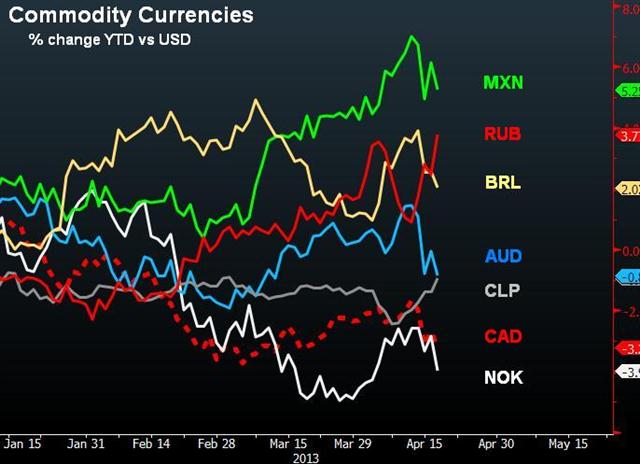
The irony of all ironies in FX: Bundesbank President Jens Weidmann hinted at lower interest rates if information warrants it, while Japanese officials are verbally supporting the yen (closely monitoring FX movements) ahead of the G20 in order to deflect accusations of currency manipulation. Both of these indications are unusual and unlikely to hold. And our insights on the BoC decision and USDCAD also included here, alongside a chart of commodity currencies.
Euro at 7-Week High, Breaks 55-DMA
The euro soared to the highest since late February as risk aversion unwound. We look at some of the reasons for the difficult-to-explain rally. The upcoming session features the Westpac Leading Index for Australia. 2 new Premium trades and a new trading note have been added to EURJPY ahead of this week's G20 meeting. The EURUSD short (dual trade) has been modified (not yet filled) ater both longs hit all targets. We also modified the existing trade in silver. Full details in the latest Premium Insights
The weak German ZEW sentiment survey was the only real news for euro traders to ponder on Tuesday but after a brief dip the euro lunged skyward – hitting 1.3200 after touching 1.3030.
There continues to be chatter about interest in European assets from Japan (French debt) and China (everything else). Otherwise there is talk of unwinding large, long-term positions in gold funded in euros.
Those stories are hard to pin down but the technicals paint a persuasive picture. The main feature at the bottom of the market was the inability to break below 1.3000/20 despite the risk rout on Monday and soft data. As EUR/USD turned higher it encountered the cluster of resistance around 1.3125 represented by the 38.2% retracement of the Feb-March fall and the 55dma. After those levels broke the 100dma quickly followed and the pair rallied as high as 1.3202 before easing back to 1.3180.
In recent EUR/USD history, the 55dma has been an important trigger. In the previous 4 instances following a close through the 55dma, the average gain/loss over the following five days is 145 pips. In 3 of those 4 instances the gains/losses over the subsequent month were substantially larger.
The upcoming session should give traders a chance to digest the recent moves. The long item on the calendar is the Feb Westpac leading index. The prior reading was +0.3% but this release rarely moves the market.
| Act | Exp | Prev | GMT |
|---|---|---|---|
| Westpac Leading Index (FEB) (m/m) | |||
| 0.3% | Apr 17 0:30 | ||
Final Thoughts on Gold
You may have read all sorts of explanations on gold's collapse on the Internet; fears of margin hikes in China, chatter that Italy (4th largest owner of gold) may start selling reserves; Fed selling GLD naked shorts in order to rebalance the 50-1 ratio of Buyers-Sellers of bullion; and violent unwinding of the short yen/long risk assets trade leading to gold liquidation. Last week we warned about the sharp drop in the Gold/S&P500 ratio, which today has reached a 5-year low. The big question now emerges as to where gold will go. 1350 has proven to be the 30% peak to trough decline, referred to in previous webinars and to our Premium subscribers. Today's bounce may lift gold towards 1400s but so far the indications suggest gold will revisit 1350s and may have the dynamics to extend further down to 1290s. Our bearish stance of the past 3 months has been mainly backed by multi-time frame momentum measures, which we converted into recommendations for our Premium subscribers with varying success due to miscalculation of stops. More importantly, trading rationales were accompanied with each trade and shift in bias. There are also important developments in the Gold/Silver ratio and the extent to which silver may add to its losses. All of this as well as the trades on USDCAD ahead of tomorrow's important BoC meeting are in the latest Premium Insights.
Wicked Moves and Wicked People
The tragedy in Boston overshadowed a fascinating trading day that featured tremendous moves in stocks, yen crosses and the bigger gold drop in 30 years. It was a classic 'risk off' day with the yen surging and commodity currencies crumbling. The minutes of the April RBA meeting are upcoming. 6 Gold and Silver longs hit all targets while 5 other metals trades are still in progress/awaiting fill. See Latest Premium Insights.
Gold spectacularly cascaded lower on Monday in a nearly $150 fall. The decline fractured many support levels and touched as low as $1335. The final key support line to break was the 55-month moving average at $1350 – it has been intact since the start of the gold bull market in 2002.
The selloff started in gold but quickly spread to other commodities, then stocks and then forex.
Margin calls could trigger a fresh wave of selling on Tuesday after the CME hiked margin requirements on gold, silver, oil and other commodities.
The forex market was generally able to withstand the pressure from commodities and stocks for most of trading but yen crosses broke down after USD/JPY dropped below 97.50. Selling accelerated after the explosions in Boston.
In any sign of war or natural disaster, the market's reaction is always to buy yen and bonds and ask questions later. As the questions begin to be answered, the reaction tends to retrace but with geopolitical events there is no set playbook. In this case, the gold/commodity drop is an ongoing and dominant factor.
USD/JPY has bounced aggressively, touching 97.10 after tumbling as low as 95.80. It is difficult to call a bottom until the commodity complex shows some signs of stability.
The main risk in Asia-Pacific trading is the minutes of the April 2 RBA meeting at 0130 GMT. The central bank retained a 'scope to ease policy further' and was slightly more dovish than anticipated. The main risk from the minutes is that they reveal policymakers are more eager to move to a neutral stance.
Finding Haven in Yen Away from Gold
The biggest daily decline in gold in over 33 years was overshadowed by the tragic news of 2 explosions at the Boston Marathon, where 2 people were killed and 23 injured. The complete absence of any rally in gold in response to the tragic events in Boston highlights the deepening erosion of gold safe havenLook out for further selling of gold and silver in Tuesday morning Asia if the Shanghai Gold Exchange proceeds with warnings to raise margin requirements in gold and silver. For full charts & analysis, click here
Metals Attempt Recovery, after Asian Collapse
Gold selloff turns to a free fall to 1385 after reports of a margin calls hitting buyers at the Shanghai Gold Exchange as Chinese investors were known to be keen buyers. China's weaker than expected GDP figures coming in at 7.7% from 7.9% did not help metals either. Silver extends collapse to 23. Both gold and silver are seeing a Monday rebound, which many conclude to be bottom fishing by the central banks. That is what has been said when gold reached 1600, 1550 and 1500. We issued new trades on GOLD today (after Friday's trades were unfilled), SILVER and USDCAD with accompanying trading notes to lay out the rationale for these trades. See Premium Insights for all the new and existing trades.
| Act | Exp | Prev | GMT |
|---|---|---|---|
| Gross Domestic Product (y/y) | |||
| 7.7% | 8.0% | 7.9% | Apr 15 2:00 |
Onto China GDP and more Yen Talk
Chinese data on GDP, industrial production and retail sales is substantial risk as trading begins for the week. Ahead of the data, the moves so far have been small with the yen gaining a few pips and the kiwi edging lower. Weekly CFTC data showed a surprising lack of fresh interest in yen shorts. After 3 Premium gold shorts hit all targets on Friday, 3 new gold shorts were added on the day, which remain unfilled. See those trades and the essential 4 charts on silver and gold here http://ashraflaidi.com/premium/latest
Last week's Chinese trade data was surprisingly strong and that points to some upside risks in today's data, which is due at 0200 GMT. The most important number is Q1 GDP, which is expected up 2.0% in the quarter. Industrial production is forecast to rise 10.1% y/y and retail sales forecast to climb 12.5% y/y.
By any measure, the Chinese economy continues to roar but signs of accelerating growth could reinvigorate the Australian dollar rally after Friday's stumble.
Last week ended with a quick fall in USD/JPY on a combination of profit taking and reaction to US Treasury saying it will 'closely monitor' Japan in the currency manipulation report. The headlines came in a thin late-Friday trading and the market may have overreacted.
The phrase 'closely monitor' tends to illicit a strong reaction from traders because it's tends to be a central bank hint at action. In this case, the text seems rather satisfied with the BOJ policies and it concludes by saying, “We will closely monitor Japan's policies and the extent to which they support the growth of domestic demand.”
Commitments of Traders
Speculative net futures trader positions as of the close on Tuesday. Net short denoted by - long by +.
EUR -51K vs -66K prior JPY -78K vs -78K prior GBP -70K vs -65K prior AUD +78K vs +84K prior CAD -65K vs -63K prior NZD +25K vs +18K prior CHF -10K vs -12K prior
US Dollar Index longs at 504K vs 54K prior
The thing that stands out is the lack of fresh JPY shorts. The prior number was before the BOJ decision and even though overall shorts are at a high level, it's not extreme. This suggests that some speculators may have missed the first wave in USD/JPY and will be buying dips.
| Act | Exp | Prev | GMT |
|---|---|---|---|
| Industrial Production (FEB) (m/m) | |||
| -0.1% | 0.3% | Apr 15 4:30 | |
| Industrial Production (FEB) (y/y) | |||
| -5.8% | Apr 15 4:30 | ||