


Intraday Market Thoughts Archives
Displaying results for week of Aug 18, 2013CAD Struggles for Fifth Day, Jackson Hole Begins
The Canadian dollar couldn't catch a lift from upbeat risk sentiment after a dismal retail sales report. The Australian dollar was the best performer while the yen struggled broadly. The Asian session is quiet ahead of UK GDP and Jackson Hole later.
The euro was resilient once again on Thursday and USD/JPY is on the cusp of breaking 99.00 but trading was generally trendless. The exception was USD/CAD, which rose for the fifth day in a 215-pip rally. For the slow-moving pair, that's a significant move and puts it within sight of the June high of 106.10.
It has been a choppy market for months but USD/CAD has tended to trend for days at a time, including an 8-day rally in June. It's a risk to chase any five-day rally but the inability to climb alongside the commodity currencies is a sign USD/CAD could continue to rally.
Economic data from Canada is another reason for the loonie bulls to fret. June retail sales fell 0.6% compared to 0.4% expected but excluding autos the fall was 0.8% compared to a flat reading expected. That continues a run of ho-hum Canadian data. Combined with stresses in emerging markets, the outlook is worsening.
Looking ahead, the focus on Friday will be speakers at Jackson Hole. In years past, the symposium has set the Fed's fall agenda but Bernanke and most of the heavyweight central bankers won't be there with the exception of the BOJ's Kuroda. Expect him to reaffirm the BOJ will do whatever necessary to defeat deflation but that type of comment won't move the yen.
One interesting line of discussion will be QE. Economists are beginning to question the efficacy of bond buying especially in light of the financial risks. This debate is tipping toward caution and occurs mostly in academic circles so it could surge to the top of the Jackson Hole agenda and may have major monetary policy consequences deep into the future.
| Act | Exp | Prev | GMT |
|---|---|---|---|
| Retail Sales (JUN) (m/m) | |||
| -0.6% | -0.3% | 1.8% | Aug 22 12:30 |
| Retail Sales ex Autos (JUN) (m/m) | |||
| -0.8% | 0.1% | 1.1% | Aug 22 12:30 |
| GDP (Q2) (y/y) | |||
| 1.4% | 0.3% | Aug 23 8:30 | |
Why Fed Must Taper Treasuries & not MBS?
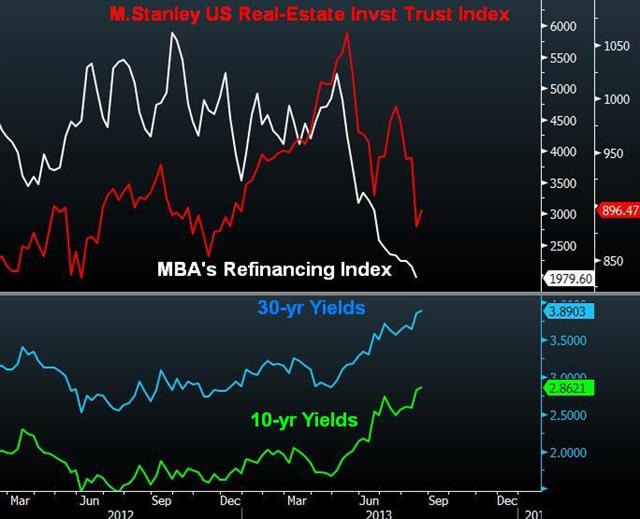
Everyone is discussing the tapering—whether it will be announced and implemented in September, or announced in September and implemented later in the year. But not much light has been shed over the composition of the tapering i.e. how much of the reduction will reduce the $45 bn in monthly purchases of long term treasuries and how much of it will trim the $40 bn in monthly purchases of agency mortgage-backed securities. More charts & analysis on why & how
Don’t Let Minutes Overshadow EM Bust
The FOMC Minutes offered few answers but left traders feeling like they were caught in a carnival ride. On the day, the US dollar was the top performer while the commodity bloc lagged. The August China manufacturing PMI is the next hurdle for traders.
The FOMC had something for everyone. FOMC participants were 'broadly comfortable' with taper 'later this year' but there was nothing specifically pointing to September. Doves were also disappointed because the Fed sounded rather cool on lowering the unemployment rate threshold.
A series of gyrations in a 50-pip range on all the USD pairs followed the Minutes as traders hemmed-and-hawed about the meaning. Ultimately, the dollar climbed higher but not substantially. One exception was cable as it tumbled to 1.5630 from 1.5710, likely due to apprehension because of nearby resistance at the June high of 1.5752.
Ultimately, the dollar rally may have been more about emerging markets. The money flooding out of several problem areas including India, Indonesia and Turkey is looking for a home and investors may have been waiting for the Minutes before pulling the trigger.
The main focus in the hours ahead if the biggest emerging market – China. HSBC releases its manufacturing PMI at 0145 GMT. The July reading was 47.7 compared to the government reading at 50.3. Economists are expecting a 48.2 prior.
With so much uncertainty in emerging markets, a negative reading here could lead to a rout and the commodity currencies are looking particularly vulnerable after the recent declines.
Emerging Market Money Floods Europe
The euro rose to a six-month high as emerging markets continued to suffer on Tuesday. Is it a coincidence? The Swiss franc was the top performer on Tuesday while the kiwi lagged. Australian skilled vacancies are the lone item on the calendar.
EURUSD broke through the 200-week moving average and its June highs – two of the major resistance levels protecting 1.37. The rally came despite large declines in periphery stock markets.
The broader story is that emerging markets continue to struggle. Indonesia is the latest victim, with the main index falling nearly 11% in the past three sessions. India was also forced to intervene as the rupee fell to a two-year low.
There are signs that safe haven flows are headed to Europe rather than the United States. Normally, disruptions in emerging markets like the ones over the past two months would lead to a dollar rally but that hasn't happened. Questions about tapering, the Treasury rout and improved European economic data may be attracting the money to Europe.
Switzerland also appears to be benefitting. USD/CHF fell to the lowest since June on Tuesday and has been stubbornly bid recently. The Swiss banks wisely developed relationships in China and elsewhere in Asia and offshore money could be seeking Swiss safety.
The focus on stocks in Indonesia and Japan threatens to steal the spotlight in the upcoming session. The lone indicators are for Australia with the Westpac leading index at 0030 GMT and DEWR skilled vacancies a half-hour later.
Yesterday, RBNZ Governor introduced targeted measures aimed to cool the housing market. The change is a negative development for the New Zealand dollar as it likely represents a shift in ideology where the central bank tries to tackle rising home prices without resorting to interest rate hikes.
Bonds and Stocks in Driver’s Seat
Treasury yields neared 3% and the S&P 500 fell to a 6-week low as the pre-tapering shakeout continued Monday. The Swiss franc was the top performer while the Australian dollar lagged. The Asia-Pacific calendar is light.
Newsflow was light but trading was brisk to start the week. The main focus was bonds and stocks as they continued to break out. The 10-year Treasury yield rose 6 basis points to 2.88%, a two-year high. At some point higher yields will attract money into US dollars but that is unlikely until yields stabilize. A zone of resistance in the 3%-3.15% range is a nearby target but aggressive selling on a break of 3% could mean some disorderly moves. In recent history, this has meant broad dollar selling but it could be a volatile, violent period.
The stock market is the other main worry. The S&P 500 fell for the fourth day and broke the 55-day moving average and the 38.2% retracement of the June-Aug rally. It's rare for stocks and bond yields to move in opposite directions but it speaks to the uncertainty of the taper.
One reason is the inability of the Fed to convince markets that a genuine recovery is underway. Rather than strong growth and inflation risks, there is a growing feeling that the Fed is tapering due to financial risks. Such a scenario fits with an environment of higher yields and softer stocks.
The FX market more-closely followed stocks as a risk-off trade spurred demand for JPY and CHF. The commodity currencies were also under pressure.
In Asia, markets will continue to search for a theme. The BOJ monthly report and Japanese leading index are the lone items on the calendar. They will be released at 0500 GMT but are highly unlikely to move the market.
Commitments of Traders Speculative net futures trader positions as of the close on Tuesday. Net short denoted by - long by +. EUR +16K vs +6K prior JPY -74K vs -80K prior GBP -46K vs -46K prior AUD -63K vs -77K prior CAD -9K vs -10K prior NZD 0K vs -2K prior CHF +2K vs -1K prior US Dollar Index longs at 16K vs 25K prior
| Act | Exp | Prev | GMT |
|---|---|---|---|
| Leading Index (JUN) [F] | |||
| 107.2 | 107.0 | Aug 19 5:00 | |
FTSE’s Ominous Yield Similarities w/ 2007
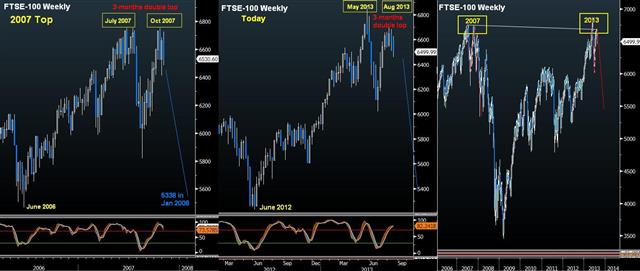
The latest chart patterns from the FTSE-100 may suggest a potential repeat of the double-top formation of 2007, which was followed by a 49% decline. This month's peak of 6,696 was a failed attempt to retake this year's high of 6,875. The failure, three months apart, bears signs of the double top from July 2007 and October 2007. See chart & analysis