



Intraday Market Thoughts Archives
Displaying results for week of Aug 04, 2013USD Malaise Continues, China CPI Next
USD/CAD fell the most in a year as the US dollar malaise continued Thursday despite a solid reading on jobless claims. The Australian dollar was the top performer while the yen lagged. The market will sharpen its focus on China in the hours ahead with inflation data on tap.
A relentless offer in USD/CAD led to a large fall in the otherwise glacial pair. The loonie was one of the last refuges of US dollar strength, along with gold, but both finally took advantage of the teetering dollar. Despite the declines, USD/CAD remained above 1.03 and the June low of 1.0245. Given the larger-than-normal moves, Friday's Canadian jobs report will be in the spotlight.
Economic data on Thursday was light. Initial jobless claims were the highlight but the report did little to change opinions, at 335K compared to 333K expected. At the margins, jobless claims are pointing to an solid US jobs picture as the four-week moving average fell to the lowest since 2007.
USD/JPY attempted to rally on the jobless claims data, hitting 96.40 and then promptly reversing and continuing to fall to a fresh six-week low of 95.81. Just as the dollar bulls were about to give up, the pair climbed off the mat along with stocks and rebounded to a flat close on the day at 96.58. The rebound paints a doji star on the chart, ending four days of declines.
The Fed's Fisher also helped to calm the frayed nerves of the dollar bulls, saying that if economic data continues to improve as the Fed expects, a September taper is coming. Fisher doesn't have much sway inside the FOMC but it's the clearest hint at a Sept 18 taper yet.
The Australian dollar shook off yesterday's jobs report and rallied on better data from China. The focus on China continues in the hours ahead of the July CPI upcoming at 0130 GMT. The consensus is for a 2.8% y/y rise along with a 2.1% drop in the PPI. Softer inflation could boost commodity currencies on speculation about stimulus.
| Act | Exp | Prev | GMT |
|---|---|---|---|
| Consumer Prce Index (JUL) (m/m) | |||
| 0.1% | 0.0% | Aug 09 1:30 | |
| Consumer Prce Index (JUL) (y/y) | |||
| 2.8% | 2.7% | Aug 09 1:30 | |
| Continuing Jobless Claims | |||
| 3,018K | 2,950K | 2,951K | Aug 08 12:30 |
| Initial Jobless Claims | |||
| 333K | 336K | 328K | Aug 08 12:30 |
US Dollar: Time to Worry?
4 weeks ago, the USD index was at 3-year highs, metals licked their wounds from the biggest decline in decades and the US growth story stood out in the headline. The Fed was considered the only major central bank capable of scaling down its quantitative easing, while the ECB mulled cutting interest rates to zero. The greenback was boosted by a powerful combination of fundamental and technical moving in tandem. What changed and how far will it go? Charts & Analysis

Dollar Bulls Getting the Dollar Blues, Busy Day in Asia
The US dollar was looking for a life raft on Wednesday as it continued to the post-NFP slide. The loonie was the only currency that performed worse while JPY made large gains across the board. Australian jobs and the BOJ decision highlight an action-packed session. We issued a change of bias in our USDJPY stance in today's Premium Insights. But pay close note of the importance to respect the major trendlines, as was seen in late June.
The pound continued higher in US trading, breaking 1.55 and touching 1.5530 before edging back. As Ashraf explained, the upbeat GBP reaction is all about growth. To put the BOE forecasts in perspective, just one of 48 economists surveyed by Bloomberg sees 1.4% growth this year with the median at 1.0% and the European Commission forecasting 0.6%. It's a similar story for 2014 with the consensus a full percentage point below the BOE's 2.6% forecast.
The question is: How will Carney react if/when growth misses his estimates. That will be a question for another day because for now, the huge bullish candle dominates the cable chart.
The Canadian dollar was hit with a double-dose of bad news as the Ivey PMI and building permits both plunged. The loonie is on shaky footing, especially against the high-flying yen.
One of the factors underpinning the yen (and weighing on the Nikkei) over the past week has been speculation about tax hikes. As we mentioned yesterday, the government appears committed to planned sales tax increases despite the fragile economy.
Now there is talk that the government could switch to 1% incremental increases in the sales tax. This may be a way to ultimately slow the pace of tax hikes while maintaining confidence in the bond market, something that could boost USD/JPY.
In the near-term, however, all eyes are on the BOJ ahead of today's decision. No change in the economic assessment or policy is expected so it could be a dull decision. The risk is that policymakers express some disappointment in the economy and that could spark a USD/JPY rally on stimulus speculation.
The other main event is at 0130 GMT with the Australian July employment report. The consensus estimate is for 6K new jobs and a one tick rise in unemployment to 5.8%. AUD bears are running out of reasons to sell: the RBA is less dovish and China has stabilized. An upbeat jobs report could spark a squeeze.
| Act | Exp | Prev | GMT |
|---|---|---|---|
| Ivey PMI (JUL) | |||
| 45.7 | 56.6 | Aug 07 14:00 | |
| Ivey PMI s.a (JUL) | |||
| 48.4 | 57.0 | 55.3 | Aug 07 14:00 |
| Building Permits (m/m) | |||
| -10.3% | -3.0% | 5.8% | Aug 07 12:30 |
| Employment Change s.a. (JUL) | |||
| 5,000 | 10,300 | Aug 08 1:30 | |
| Fulltime employment (JUL) | |||
| -4,400 | Aug 08 1:30 | ||
| Part-time employment (JUL) | |||
| 14,800 | Aug 08 1:30 | ||
| Unemployment Rate s.a. (JUL) | |||
| 5.8% | 5.7% | Aug 08 1:30 | |
GBP Clashes Against JPY
Sterling may have stolen today's FX headlines, but the yen is the day's biggest performer. The deteriorating losses in global equities and inevitable start of Fed's tapering have been mentioned as convenient explanations for the yen's rally. Tonight's BoJ decision may also be causing nervousness with regards to the lack of reiterating the central bank's anti-inflationary commitment. The shift in negativity in most yen crosses from daily and weekly charts to converging bearishness in monthly momentum has escalated the debate about he long term sustainability of USDJPY.
Why did GBP Rise on Carney's Guidance?
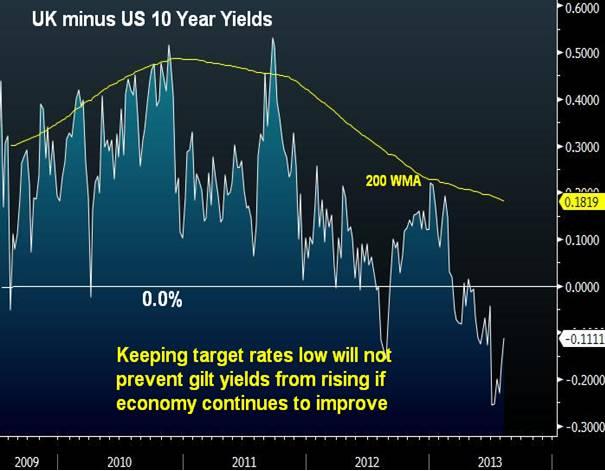
The Bank of England has finally introduced a 7% unemployment threshold as part of its forward guidance, implying that monetary policy will not be tightened unless the ILO measure of unemployment nears 7% from its current level of 7.8%. So why did GBP rally on the news and Carney's testimony? Full chart & analysis
US Dollar Struggles Continue, NZ Jobs on Target
The US dollar continued its descent following Friday's non-farm payrolls report. The kiwi was the best performer while fellow commodity currency CAD lagged. Early in Asia-Pacific trading, the unemployment rate rose to 6.4%.
The US dollar had several reasons to rally on Tuesday but ignored them. One was a less dovish comment from one of the biggest doves at the Fed. Chicago Fed president Evans said tapering was 'quite likely' to start this year and dismissed fears about rising mortgage rates. The June JOLTS survey, which measures job openings, also rose to a multi-year high. Most importantly, Ashraf detailed the upbeat trade figures and the positive implications for the dollar.
The dollar was unable to gain any traction on these headlines. Instead, USD/JPY traders focused on falling stock markets and others focused on a signal that tapering could be delayed. Atlanta Fed president Lockhart said curtailing QE is not definite if the economy is 'moping along.'
USD/JPY slid to a one-month low at 97.51 as the S&P 500 declined 0.6%. A report from Nikkei cited draft copies of government fiscal plans that continued to indicate sales tax hikes.
The New Zealand dollar was slightly weaker after the Q2 employment report showed unemployment at 6.4% compared to 6.3% expected. The rate of jobs growth matched expectations but the participation rate ticked higher so the RBNZ is unlikely to stir. One area that could lead them to back away from rate hikes is a 1.7% rise in private sector wages compared to 1.8% expected.
Later, the highlight is Australian home loans for June at 0130 GMT. AUD/USD has remained buoyant since the RBA decision and a good data point could spark a squeeze above 0.9000. Expectations are for a 2.0% m/m rise. The BOJ also starts its two-day meeting.
| Act | Exp | Prev | GMT |
|---|---|---|---|
| JOLTs Job Openings (JUN) | |||
| 3936 | 3895 | 3907 | Aug 06 14:00 |
| Home Loans (JUN) | |||
| 2.0% | 1.8% | Aug 07 1:30 | |
| ANZ Job Advertisements (m/m) | |||
| -1.10% | -1.60% | Aug 06 1:30 | |
| Employment Change (Q2) | |||
| 0.4% | 0.4% | 1.7% | Aug 06 22:45 |
| Unemployment Rate (Q2) | |||
| 6.4% | 6.3% | 6.2% | Aug 06 22:45 |
| Labor Cost Index (q/q) | |||
| 0.4% | 0.5% | 0.4% | Aug 06 22:45 |
Remember the US Trade Deficit?
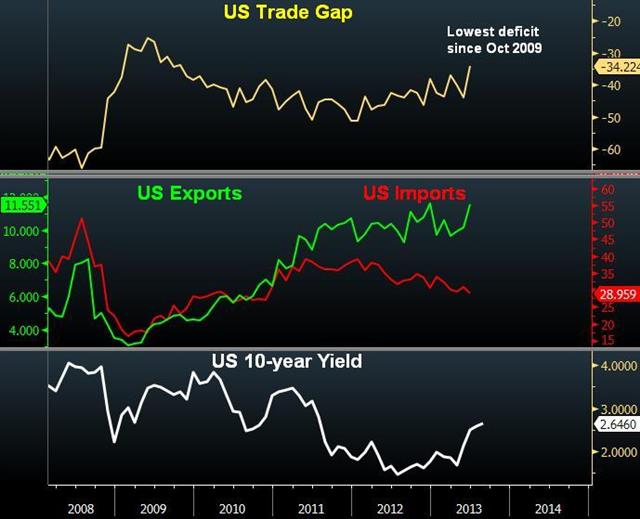
The US trade deficit fell 22% in $34.2 bn, reaching its lowest level since October 2009. The 22% decline was the biggest in over 4 years. Currency traders haven't focused on the US trade deficit since the mid 2000s, when it exceeded 6% of GDP. Today, it is half that level. Chart & analysis
ISM Beats, RBA Decision Looms
The US dollar failed to make any headway on the strong ISM service sector report since February. The yen was the best performer while EUR and NZD lagged. The Reserve Bank of Australia is expected to cut interest rates later today.
The ISM non-manufacturing index jumped to 56.0 in July compared to the 53.0 expected, matching the highest reading this year. New orders were strong but employment slightly weaker, giving some confirmation to Friday's ho-hum jobs report.
USD/JPY rose to a session high of 98.77 following the report but the knee jerk higher marked the top for the day and the pair drifted to 98.25 later. Similarly, EUR/USD fell to 1.3232 but couldn't go any lower and rebounded to 1.3263. The dollar also failed to gain after the Fed's Fisher commented that the FOMC is now closer to tapering.
Throughout the session, the market lacked any strong bias. EUR/CHF drew some interest as it slid below 1.23 to the lowest in a month.
In the hours ahead, attention will focus on the Australian dollar. Up first is the June trade balance report at 0030 GMT with expectations for a A$800 surplus. At the same time, the house price index for Q2 is expected up a modest 3.0% y/y.
The main event is at 0430 GMT when the RBA announces its decision on rates. The OIS market is implying a 91% chance of a cut and 26 of 27 economists surveyed by Bloomberg forecast expect the same.
A failure to cut rates, although unlikely, would send AUD traders scrambling to cover and AUD/USD would likely to gain more than 200 pips. A cut would elicit a much smaller reaction and the focus would turn to the statement and any potential bias toward more cuts.
| Act | Exp | Prev | GMT |
|---|---|---|---|
| ISM Non-Manufacturing Composite (JUL) | |||
| 56.0 | 53.1 | 52.2 | Aug 05 14:00 |
| Trade Balance (JUN) | |||
| $-43.50B | $-45.03B | Aug 06 12:30 | |
| Trade Balance (JUN) | |||
| 800M | 670M | Aug 06 1:30 | |
| House Price Index (Q2) (q/q) | |||
| 1.0% | 0.1% | Aug 06 1:30 | |
| House Price Index (Q2) (y/y) | |||
| 3.0% | 2.6% | Aug 06 1:30 | |
| ANZ Job Advertisements (JUL) | |||
| -1.8% | Aug 06 1:30 | ||
| Employment Change (Q2) | |||
| 0.4% | 1.7% | Aug 06 22:45 | |
| Unemployment Rate (Q2) | |||
| 6.3% | 6.2% | Aug 06 22:45 | |